Collaborative Problem Solving Workshop That Works
The meeting has gone sideways. A customer has changed direction, a project deadline has moved up, and the people in the room are defending their own piece of the work instead of building a response together. That is exactly where a collaborative problem solving workshop earns its place. Teams do not need another lecture about collaboration. They need practice responding well when the answer is not obvious.
For leaders, HR professionals, and event planners, the goal is bigger than getting people to participate in a fun session. The goal is to help people listen accurately, contribute useful ideas, make decisions with incomplete information, and move forward without creating more friction. When those habits improve, teams spend less time circling the problem and more time solving it.
Why capable teams still get stuck
Most workplace problem solving failures are not caused by a lack of intelligence. They happen because communication breaks down under pressure. One person rushes to provide the answer. Another withholds an idea because the conversation feels closed. A manager tries to control every detail. The group starts talking past one another, and urgency gets mistaken for progress.
Remote and hybrid work can add another layer. A quick clarification that might have happened in a hallway becomes a long email chain. Tone gets misread. Ownership becomes fuzzy. By the time the team reconnects, people may be attached to competing solutions rather than aligned around the real issue.
A strong workshop makes these patterns visible without turning the session into a blame exercise. Participants get to experience what happens when they assume, interrupt, over-explain, or dismiss a contribution too quickly. More importantly, they practice better alternatives in a setting where the stakes are low enough to learn and high enough to feel relevant.
What a collaborative problem solving workshop should build
The best workshops are active because collaboration is an action, not a slide deck. Participants need opportunities to test their habits in real time, receive feedback, adjust, and try again. That repetition is what turns a good idea into a usable workplace behavior.
Better listening when the details are changing
Teams often lose time because everyone is solving a slightly different version of the problem. Effective problem solvers listen for facts, concerns, constraints, and assumptions before they jump to a recommendation. They can summarize what they heard, ask a clarifying question, and keep the group focused on the issue rather than the loudest opinion.
This is especially valuable for leaders. When a leader listens visibly, the team is more likely to surface information that would otherwise remain buried. That does not mean every idea gets equal weight. It means decisions are based on a fuller picture.
Clear contributions instead of competing monologues
A productive team conversation has momentum. Each person adds to the shared work rather than resetting the discussion around their own point of view. That requires concise communication, awareness of timing, and the confidence to contribute before an idea is perfectly polished.
In a workshop setting, people can practice making their point clearly, connecting it to what has already been said, and inviting the next useful contribution. These are small communication shifts, but they change the emotional temperature of a meeting. People feel heard, and the group can build rather than battle.
Adaptability without panic
Change is not the problem. The unproductive reaction to change is the problem. When priorities shift, high-performing teams can separate what is fixed from what is flexible. They identify the next decision, assign ownership, and adjust the plan without losing their composure.
That adaptability is not the same as agreeing to everything or abandoning good judgment. Sometimes the right response is to slow down, gather more information, or challenge an unrealistic request. A capable team can do that constructively while still helping the business move forward.
Confidence to act before every answer is available
Many business problems arrive with missing data, competing priorities, and no clean solution. Waiting for certainty can create its own risk. Teams need a practical way to generate options, test what is workable, and commit to the next move.
A well-designed session helps participants become more comfortable with that uncertainty. They learn that a useful contribution does not need to be a flawless final answer. It can be a question that reveals a gap, an option that moves the discussion forward, or a clear next step that creates momentum.
Make the workshop feel like the work
Generic team-building can create a temporary lift without changing what happens in Monday’s meetings. The difference is relevance. A collaborative problem solving workshop should be built around the situations participants actually face: cross-functional handoffs, customer escalations, difficult internal conversations, leadership decisions, project changes, or teams that need to work through disagreement faster.
Before the session, clarify what is getting in the team’s way. Are people reluctant to speak up? Does one department dominate decisions? Are managers struggling to lead when plans change? Is the team creative but unable to turn ideas into action? The answer shapes the emphasis.
A sales team responding to shifting client expectations needs different practice than an operations group managing handoffs. An executive team may need to sharpen decision conversations, while newer managers may need more confidence guiding a group through ambiguity. The core skills overlap, but the scenarios, language, and level of challenge should fit the room.
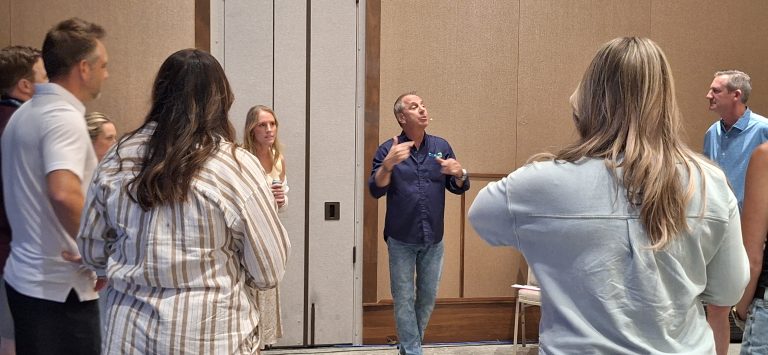
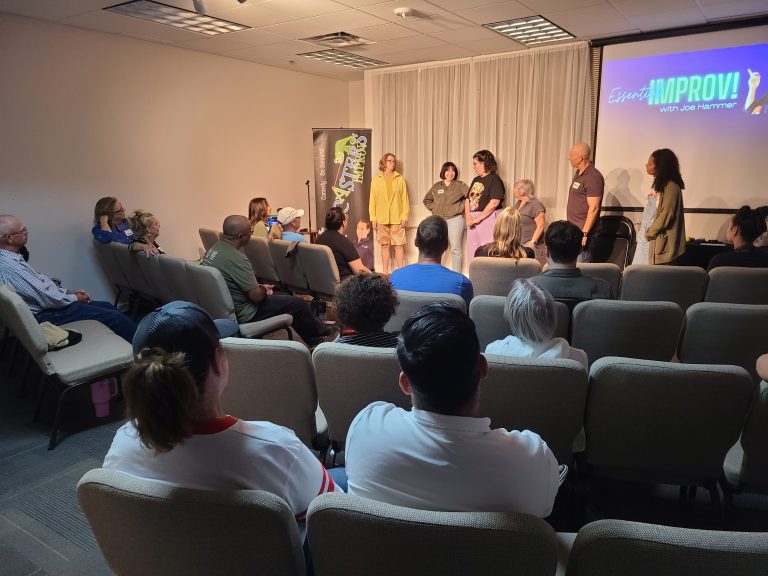
This is why experiential, improvisation-based training works when it is handled as business development, not entertainment. The exercises create immediate feedback. Participants see how their choices affect clarity, trust, speed, and outcomes. Then they connect those observations directly to real workplace interactions.
What leaders should look for in a facilitator
The facilitator matters as much as the agenda. A strong facilitator brings energy, but energy alone is not enough. They need to understand how adults learn, how teams behave under pressure, and how to keep a room engaged without making anyone feel exposed for the sake of a laugh.
Look for someone who can challenge participants while maintaining psychological safety. The session should be lively, but never childish. It should be practical, but not so rigid that people only memorize a process. The right balance helps people take risks, learn from missteps, and leave with language they can use in their next conversation.
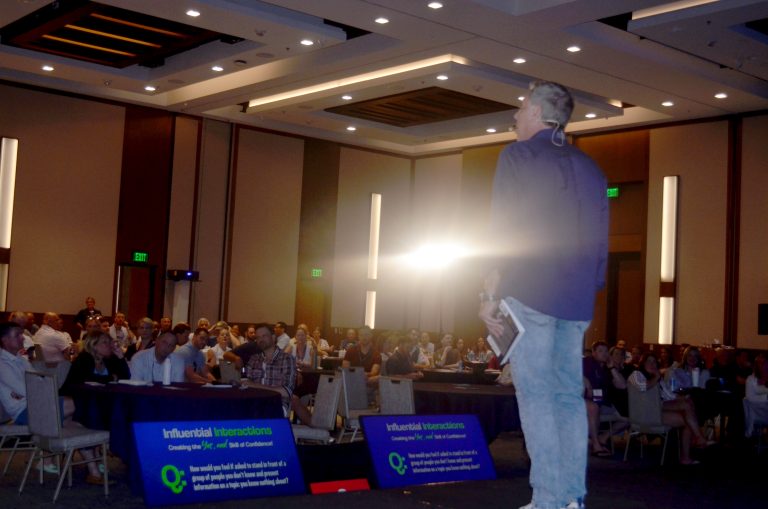
Customization also matters. A conference keynote may need a high-energy shared experience that gives hundreds of attendees a memorable communication tool. A department workshop may need more time for practice and application. An executive offsite may require sharper discussion around influence, decision-making, and leadership presence. One format does not fit every need.
Your Improv Coach designs programs around those real-world objectives, using active practice to strengthen communication when circumstances are moving fast.
Turning the session into better daily behavior
A workshop should not end when the room clears. To make the learning stick, leaders need to reinforce the behaviors in normal work. That can be as simple as asking better questions in meetings: What problem are we solving? What have we heard that changes our view? What is the next decision? Who owns it?
Managers can also notice and name progress. When someone summarizes a complex issue clearly, invites a quieter colleague into the conversation, or helps the group reset after a new development, point it out. Specific recognition tells the team what effective collaboration looks like in practice.
It also helps to choose one recurring moment where the team will apply the skills deliberately. That might be a weekly project meeting, a customer escalation review, or a planning session. The point is not to force every conversation into a script. It is to create enough repetition that productive collaboration becomes the team’s default response.
The real test of a workshop is not whether people enjoyed the activity, though they should. It is whether, weeks later, a team facing a difficult problem can stay present, hear one another, generate useful options, and take the next smart step together. That is the kind of practice that makes pressure feel less like chaos and more like a moment to lead.
Turn this kind of collaboration into your team’s default response. Request a free workshop consultation with The Outcasters’ corporate improv training team.

As founder of The Outcasters Improv Training Center and YourImprovCoach.com, Joe Hammer has spent years helping forward-thinking organizations build real skills in listening, collaboration, and adaptability under pressure through interactive, improv-based training. His engagements often open with a high-energy presentation on using principles of improv in effective business communication, a great way to set the tone at a conference, offsite, or leadership summit, before teams move into hands-on training.