12 Best Leadership Retreat Activities That Work
A leadership retreat can either change how people work together on Monday morning or become a pleasant break from work that fades by Thursday. The difference is not the venue, the catered lunch, or the slide deck. The best leadership retreat activities put leaders in situations that reveal how they listen, decide, communicate, and respond when the plan changes.
For executive teams, department heads, and rising managers, the goal is not to manufacture vulnerability or fill a schedule with generic team-building. It is to create productive pressure, give people useful feedback, and practice the behaviors that matter when deadlines tighten, priorities shift, and conversations get difficult.
What Makes a Leadership Retreat Activity Worth the Time?
A strong activity has a clear workplace purpose. Participants should understand what capability they are building and where they will use it: running a better meeting, handling disagreement without defensiveness, making a decision with incomplete information, or communicating a change with confidence.
The activity also needs enough challenge to make default habits visible. If every task is easy, leaders can remain polished and protected. When an exercise requires quick coordination, competing priorities, or a real-time response, people see how the team operates under pressure. That is where useful learning begins.
Finally, the debrief matters as much as the activity. Ask what happened, what helped, what got in the way, and what the team will do differently in actual business conversations. Without that bridge, even an engaging retreat can feel disconnected from the work.
12 Best Leadership Retreat Activities for Real Team Growth
1. The Decision-Making Pressure Test
Give small groups a realistic business scenario with limited facts, a short deadline, and competing stakeholder needs. It could be a customer escalation, a sudden budget reduction, an operational failure, or a high-visibility communications issue. Each group must decide what it will do, what it needs to know, who owns the next step, and how it will communicate the decision.
This reveals whether leaders clarify assumptions, assign ownership, and make progress without waiting for perfect information. It is especially useful for teams that get stuck in analysis or leave meetings with agreement but no action.
2. Rotating Meeting Leadership
Run a brief meeting on a genuine business topic, but rotate the meeting leader every five or seven minutes. Each new leader inherits the conversation exactly where it is, including confusion, competing opinions, or a participant who has not been heard.
The exercise builds presence and listening discipline. Leaders quickly learn that facilitating is not about controlling every answer. It is about keeping the purpose clear, drawing out useful perspectives, and moving a group toward a decision.
3. The Stakeholder Response Simulation
Leadership teams rarely communicate with one audience. A decision that makes sense to the executive team may concern frontline employees, frustrate customers, or raise questions for a board member. In this activity, participants receive the same business development but must respond to different stakeholder roles.
One leader may deliver the message while others play employees, customers, partners, or senior executives. The group practices handling questions in the moment without becoming vague, defensive, or overly scripted. It is a practical way to strengthen influence and message discipline before a real announcement is on the calendar.
4. Build the Story of a Tough Win
Ask each leader to bring a recent success that was not clean, easy, or individual. In pairs or small groups, they tell the story in three minutes: the challenge, the turning point, the choices made, and the contribution of others.
This is not a bragging exercise. It helps leaders recognize the operating behaviors behind good outcomes. Teams often discover patterns worth repeating, such as early escalation, clearer ownership, better customer listening, or willingness to test a solution before it is perfect. It also gives newer leaders access to hard-earned judgment that usually stays unspoken.
5. The Constraint Challenge
Give teams a problem to solve, then add constraints as they work. A key resource disappears. The timeline is cut in half. A new stakeholder changes the success criteria. The point is not to catch people off guard for entertainment. It is to observe how they adapt.
When pressure rises, some teams become quiet, others overtalk, and others rush toward the first idea. A well-facilitated constraint challenge helps leaders practice staying composed, inviting useful input, and adjusting direction without spreading panic. These are the same skills needed when a client changes course or a major presentation takes an unexpected turn.
6. Blind Spot Feedback Pairs
Pair participants and provide a focused feedback structure. Each person identifies one leadership behavior they want to strengthen, then asks their partner for observations based on real work interactions. Keep the feedback specific: what the person does, the effect it has, and one behavior to try next.
This works best when the retreat has already established trust and confidentiality. It should not become a dumping ground for unresolved grievances. The value comes from direct, respectful feedback that leaders can use immediately, especially when it addresses communication habits they may not see in themselves.
7. The Cross-Functional Hand-Off Map
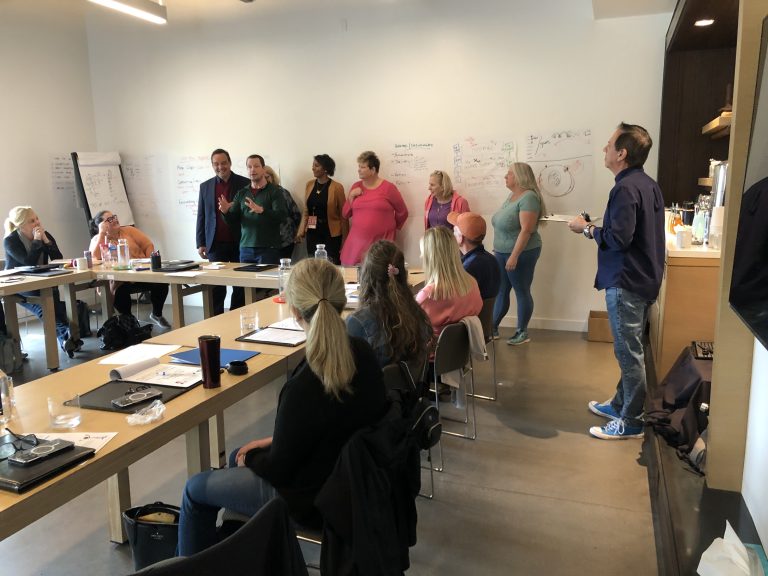
Choose a real process that regularly creates friction: onboarding a client, approving a project, responding to a service issue, or launching a new initiative. Leaders map the hand-offs between functions, including where information stalls, decisions get delayed, or expectations become unclear.
The discussion often surfaces a simple truth: many performance problems are not caused by a lack of effort. They are caused by unclear communication across teams. End the activity by identifying one hand-off the group will redesign, not ten problems that nobody owns.
8. Practice the Difficult Conversation
Avoid vague role-play. Use scenarios that sound like your organization: a high performer missing collaboration expectations, a manager resisting a needed change, two leaders with conflicting priorities, or an employee who needs clear developmental feedback.
Participants take turns leading the conversation while observers watch for clarity, composure, listening, and follow-through. The facilitator can pause the exchange, invite a second approach, and let the leader try again. That repetition is valuable. Leaders do not become more confident in difficult conversations by reading a model answer. They improve by practicing the moment as we demonstrate in my Influential Interactions Communications Program.
9. The One-Page Priority Debate
Before the retreat, ask leaders to prepare a one-page case for the priority they believe deserves the most attention in the next quarter. During the session, they make their case, field questions, and then work toward a shared ranking.
This activity exposes competing assumptions without turning the discussion into a political contest. It is useful when a leadership team says everything is important, which usually means people are about to spend energy in too many directions. The outcome should be a sharper set of priorities and a clearer explanation of why they matter.
10. Real-Time Communication Drills
Create short, fast-paced scenarios in which a leader must respond to a changing request, an unexpected question, or a misunderstood message. The group then reflects on what made the response credible and what created confusion.
Interactive communication drills are particularly effective for leaders who know their material but become less clear when the room pushes back. The aim is not polished performance. It is the ability to listen, think clearly, and respond productively without retreating into jargon or a rehearsed script.
11. Leadership Commitments in Public
At the end of a major working session, ask every participant to name one behavior they will start, stop, or strengthen. Make the commitment observable. “Communicate better” is not a commitment. “Send a decision recap with owner and deadline within 24 hours of each leadership meeting” is.
Peers can then ask one useful question: what might prevent you from following through? This keeps the conversation honest and turns good intentions into a plan that can be revisited after the retreat.
12. The 30-Day Accountability Exchange
Close the retreat by pairing leaders as accountability partners. Each partner schedules a short check-in within 30 days and agrees to ask about the commitment made during the retreat. If the organization wants stronger follow-through, a senior sponsor can also build a brief progress review into an existing leadership meeting.
This may sound simple, but it solves one of the biggest retreat problems: momentum disappearing when normal work returns. Behavior change needs a return to the work, not a perfect closing ceremony.
Choosing Activities for Your Leadership Team
Not every activity belongs in every retreat. A newly formed leadership team may need more time building working trust and communication norms. A seasoned executive group facing a major change may benefit more from decision simulations, stakeholder messaging, and conflict practice. If the team has unresolved interpersonal tension, forcing high-energy competition can make matters worse; structured conversations and skilled facilitation are a better starting point.
The strongest agenda usually mixes reflection with action. Leaders need room to step back from the daily rush, but they also need to practice what they want to do differently. That is why experiential, business-focused sessions tend to stay with people longer than passive presentations or entertainment-only activities.
A retreat earns its place on the calendar when leaders leave with fewer assumptions, clearer commitments, and more confidence in the conversations waiting for them back at work.

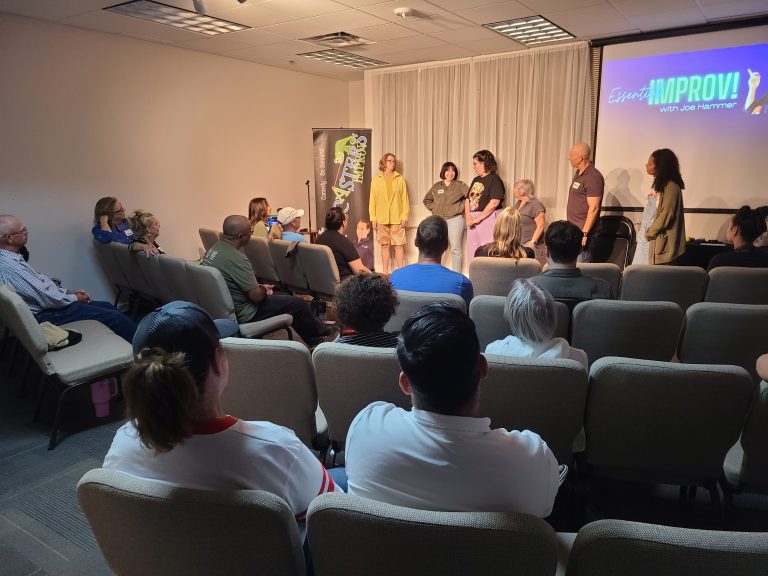
As founder of The Outcasters Improv Training Center and YourImprovCoach.com, Joe Hammer has spent years helping forward-thinking organizations build real skills in listening, collaboration, and adaptability under pressure through interactive, improv-based training. His engagements often open with a high-energy presentation on using principles of improv in effective business communication, a great way to set the tone at a conference, offsite, or leadership summit, before teams move into hands-on training.